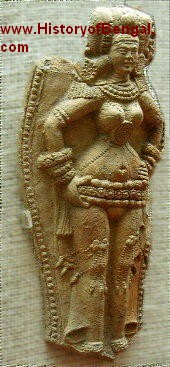
Courtesy: W.B. State Archeo. Museum |
Have you heard of:
Chandraketugarh or Khana-Mihirer Dhipi?There is a fascinating place near Kolkata (West Bengal, India) where a bustling town from the days of Emperor Asoka is buried under the present day ricefields and village cottages. If you go there, you won't see much at first. But look down on the ground you're walking on, and you'll see something unusual. The ground appears strewn with a variety of potsherds. In fact, whenever the ground of Chandraketugarh is dug to build a house or to dig a pond, a variety of elegant and sophisticated artifacts is routinely unearthed. All available information points to a mature civilization centered around a busy port, which started flourishing in this area more than 2000 years ago. Indeed, it is thought to belong to the kingdom of a "mighty ruler" of whom Alexander the Great was familiar. Plutarch wrote about a powerful tribe called "Gangaridae" living near a prosperous port "Gange" in the Gangetic delta. From geographical description the Chandraketugarh area can be linked to this port. The inhabitants of Chandraketugarh achieved spectacular artistic refinement and created artifacts of exquisite beauty. Influence of foreign art raises intriguing questions. The numerous materials collected from this site point to a rich cultural and social life. Why did it vanish without a trace? We embark upon a journey to learn more, especially through the terracotta art of Chandraketugarh. |
Chandraketugarh
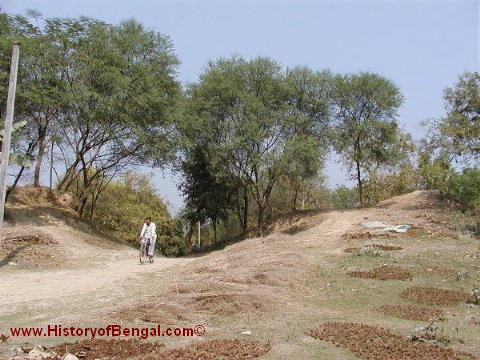
| Take a look at the photo below. We see a cyclist happily riding on a country road, through, which seems like two unassuming mounds of the kind we see everywhere in India. But these are no simple mounds! Buried under these mounds are the fortified ramparts of an ancient community -- the fort of King Chandraketu. The cyclist is unknowingly passing through what used to be one of its main entrances. The mound on the right is now called the "burz", and probably used to be a sentry tower. Archeologists have excavated numerous items dating back to the 3rd Century BC (the Pre-Mauryan Era in India) from the bottom of these ramparts and the surrounding area. |
|
I took the above photo at a place called Berachampa
(the site of Chandraketugarh) about 38
km northeast of Kolkata (India). The person seen in the photo probably lives
close by, and almost certainly doesn't know anything about the history
of the place.
Unfortunately, we don't know a whole lot either. There is no written record of this civilization. More mysterious is the fact that it vanished leaving no social memory in the surrounding area other than some local mythologies. Yet, there is no doubt that the civilization reached a very high level of sophistication (not possible in a short span of time) evidenced by the enormous amount of artifacts it is still routinely generating. Sounds interesting? Follow me through these pages and I will present you the fascinating facts and several photo albums of my journey to this place. |
Khana-Mihirer Dhipi (The Mound of Khana-Mihir)
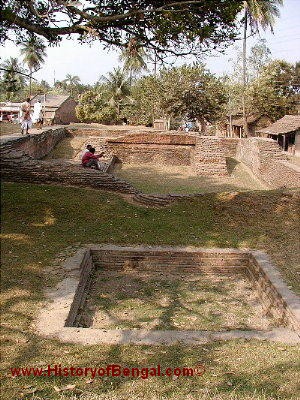
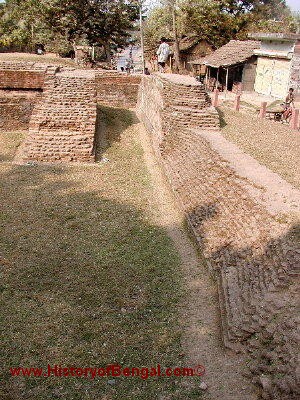
| Only a few kilometers from where I took the above photo, there are the ruins of a massive temple structure. Locally called the Khana-Mihirer Dhipi or the mound of Khana-Mihir, it has survived for almost a millenium in the form of another deserted mound. An excavation in the 1950s uncovered the structure (see the photos below). No one knows for sure how or when the names of Khana (pronounced khauna) and Barahamihir came to be associated with it. Barahamihir was one of the nine jewels in the court the famous Indian emperor Vikramaditya (also known as Chandragupta-II). Khana was his wife (daughter-in-law, according to another opinion). The ruins are now conjectured to belong to a Vishnu temple from the Gupta period. Who built the temple? Did it simply decay because of neglect or was it destroyed? We don't know. However, the temple complex was likely inside the fortification that we see at Chandraketugarh. For more details and a journey to this place. |
|
|
| Wikipedia page on Chandraketugarh: https://en.wikipedia.org/wiki/Chandraketugarh |
If you have any question, please contact me at ambarish@ambarish.com
Last Revised July 18, 2022
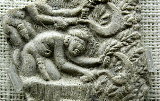
Courtesy: W.B. State Archeo. Museum